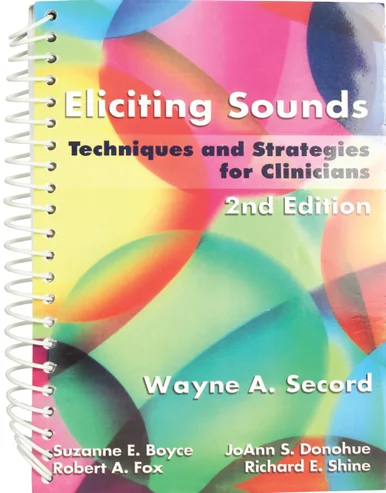

Eliciting Sounds: Techniques and Strategies for Clinicians (2nd Edition) is a practical, clinician-oriented handbook designed to help speech-language pathologists, therapists, and students successfully evoke and remediate speech sounds — especially when clients lack the target phoneme in their repertoire. Barnes & Noble+1
This edition offers a compact, easy-to-use collection of phoneme-specific methods, articulatory placement strategies, motor-kinesthetic cues, and sound approximation techniques — allowing clinicians to immediately begin working on any English sound, whether consonant or vowel. Cengage+1
Whether you’re working with children or adults, beginners or advanced therapy cases, this book provides structured, evidence-based and field-tested approaches to help clients achieve accurate speech production. It’s written by experienced speech-language professionals and remains one of the most trusted resources in articulation therapy. R2 Digital Library+1
🔎 Key Features & Benefits
-
Comprehensive sound coverage — covers all English consonant and vowel phonemes, including challenging sounds like liquids, fricatives, affricates, diphthongs, and /r/ sound variations. Barnes & Noble+1
-
Phonetic placement & motor-kinesthetic techniques — clear, practical instructions on tongue/lip placement, airflow, voicing, and voiceless sounds to help clients who cannot produce certain sounds at all. Cengage+1
-
Sound elicitation checklists & strategies — quick reference for clinicians needing to evoke target sounds immediately, especially useful in assessment or early therapy sessions. R2 Digital Library+1
-
Useful for a wide range of clients — works for children or adults with articulation or phonological disorders, speech delays, lisps, or other sound production difficulties. My Books Joint+1
-
Compact, clinician-friendly format — spiral-bound (or manageable paperback), making it easy to use in therapy sessions, school environments, or private practice. Barnes & Noble+1
-
Trusted by professionals & recommended resource for students — widely cited in speech-language pathology programs, clinics, and therapy settings. R2 Digital Library+1
🎯 Who Should Use This Book
-
Speech-language pathologists (SLPs) working with articulation/phonological disorders
-
Students in speech-language pathology or communication sciences courses
-
Therapists and clinicians working in child speech therapy, school therapy, or private practice
-
Educators and special-education professionals who support speech therapy needs
-
Anyone needing a practical guide to deliver sound elicitation and articulation therapy
🌟 Why This Book Is Recommended
When clients don’t respond to standard methods and struggle to produce certain sounds, this book becomes indispensable — offering multiple strategies and phoneme-specific techniques rather than a one-size-fits-all approach. Its organization by sound, clear instructions, and clinically tested methods make it a go-to manual for both new and experienced clinicians striving for effective therapy outcomes.






Reviews
There are no reviews yet.